Tuesday, 28 February 2017

Airbus to display resilient PMR communications infrastructures and solutions at ShieldAfrica 2017

ShieldAfrica was started in 2013 and is a security conference for institutional and private operators to meet with companies to promote products and ideas, this years (2017) main theme is Safe Cities, component of Smart Cities, driving investment and economic development to the concept of connected and safer cities. Airbus are turning up to this years exhibition and they are showing off their PMR infrastructures, the source of the article is here, but you can read the whole lot below


To support the economic development of African societies and governments in a challenging security context, Airbus Defence and Space will show its latest radiocommunications technologies at the exhibition “ShieldAfrica” in Abidjan, Ivory Coast, in late January 2017.

Police, firefighters, and rescue services in Africa are increasingly in demand of more advanced and secured mobile communication tools. “ShieldAfrica” serves as a platform to discuss security applications which require sophisticated Professional Mobile Radio (PMR) technology on the continent.

Secure communications infrastructures

“Government organisations, such as police and emergency first responder services, need secure communications infrastructures for the whole of their national territory and also for critical sites, such as airports, ports and stadiums,” says Philippe Devos, Head of Strategic Campaigns and Government Affairs of Secure Land Communications at Airbus. “We can offer the needed communication means in Africa based on our profound experience as a world-leading PMR provider.”

African security and defence sectors

“Shieldafrica” is a key event for the African security and defence sectors and hosts the major players in this field, for instance African governments, the global security and defence industry and representatives of diplomacy. Besides showing newest achievements in mission critical communications, Airbus will also showcase the following solutions:


  • Tetra digital radio systemsassociated with modern command and control applications and handheld radios can support effectively shared network deployment models. With these systems at hand, dispatching positions of vehicles or persons can be managed easily by geolocalising Tetra subscribers or groups.


  • The Tactilon Agnetapp brings Tetra push-to-talk to an LTE smartphone. It allows users of commercial LTE networks to communicate securely within mission-critical Tetra networks.


  • The Tactilon Dabat, a smartphone and full Tetra radio in one device, enables users, such as police or firefighters, to operate securely with multimedia functions.


Providing interoperability

For more than 25 years, Airbus has equipped various governments around the world with resilient PMR communications infrastructures and solutions. The company has a proven track record of nationwide deployments providing interoperability to all security users organisations.

Tuesday, 7 February 2017

Far offshore windfarms present communications challenges

This is an interesting article debating the different types of communication that can be used over a long distance, and as they distance moves further and further, the different types of communication drop off or become part of an infrastructure. As engineers battle with this problem, knowledge of how radio frequencies and applications becomes paramount.

As offshore windfarms are built further and further from land, alternatives to conventional VHF communications are going to be required

A cornerstone of any major project is clear communication between all parties. As we move windfarm construction further offshore, maintaining efficient voice and data communications becomes essential. With many projects now being constructed beyond the range of VHF radio and cellular telephone, such as a Gemini or Dudgeon offshore windfarms, crew transfer vessel (CTV) operators and their clients are experiencing challenges achieving practical and affordable offshore communications. My experience on two far offshore projects in the last 15 months has shown that creative thinking can work together with existing equipment such as TETRA radio to reduce the risks and stress that poor communications can generate.

Communication solutions on offshore windfarms depend on the phase that the operation is in, the size of the project and the distance from shore. Many smaller, older windfarms rely on VHF radios to communicate between shore and vessel and shore/vessel and work team on the turbines. However, VHF is limited in range being a line-of-sight system, and the signal has trouble penetrating structures such as wind turbines due to the Faraday cage effect. Conventional cellular telephone coverage is also possible on nearshore sites, with some windfarms installing a cellular mast within the windfarm. Vessels at anchor off the Dutch port of IJmuiden can thank the windfarm industry for good connection when waiting for a pilot if they have contracts with the provider KPN.

When moving further offshore, luxuries such as a cellular mast will not be installed during the construction phase, and it is most likely that VHF radios will not be sufficient. It is common for the developer to install a TETRA radio network â€" similar to those used by national emergency response services such as police and fire departments.


TETRA, or terrestrial trunked radio as it is properly termed, is a secure network allowing one-to-one, one-to-many and many-to-many communications. This means that the marine controller can speak directly and privately to one party or to the entire offshore spread depending on what is needed. It transmits on a lower frequency than VHF so covers a greater range. This still is not enough to cover the distances experienced on far offshore windfarms. If multiple base stations are used, each base station can then automatically rebroadcast a message thus expanding the network coverage. On a recent construction project, it was found that there were communications blackspots in the area of the sea passage from the base port to the site. This was later eliminated by fitting full base station units rather than just handheld transceivers on the CTVs. The CTVs then became vital links in the communications network and ensured the blackspots were reduced or eliminated altogether.

TETRA has many other advantages, including the ability to penetrate the tower of a wind turbine, and calls are not dropped when moving between base station carriers due to the network configuration. This is especially important if vessel-carried base stations are relaying far offshore. The network is also secure, which ensures that commercially sensitive information cannot be intercepted. With the one-to-one mode, it also means that managers can have detailed conversations on sensitive subjects.

However, anecdotal information received from vessel crews in the field appear to indicate that TETRA, although a good system, is not foolproof. One vessel master reported that, after 15 months on site, they still had blackspots with TETRA and sometimes have to use the cell phone application WhatsApp to request that turbines be started or stopped so that he can land a team.

TETRA does not solve the operational problems experienced by vessel-operating companies who require frequent voice and data communication with the CTVs to ensure a smooth delivery of service. As most sites far offshore are outside of cell phone coverage and clients demand that daily reports are issued on time, creativity is needed. There is a simple solution that could solve all of the communication problems far offshore â€" installing VSAT satellite communications on each CTV, which allows instant telephone and data transfer.

However, the practicalities of chartering in today’s windfarm industry eliminates this option, as the client will not want to pay for installation and operation, and a vessel owner cannot afford such a luxury. Charterers therefore need to make a decision: either they assume responsibility and the costs for practical workable satellite communications on their vessels or look for practical alternative solutions to deliver what is needed far offshore.

One practical solution to maintain communications between the marine co-ordination centre and vessels is to step back a generation and use medium frequency/high frequency single side band radios, which are common equipment on larger CTVs and is standard on service operation vessels (SOVs) or installation vessels.

When used in conjunction with the digital selective calling (DSC) function of the GMDSS standard, voice communications can be maintained at long distance without operating cost. Unfortunately, current guidance for the marine co-ordination in windfarms as found in the G9 Good practice guideline: The safe management of small service vessels used in the offshore wind industry does not yet consider marine co-ordination and communications in far offshore windfarms.

Another practical solution to improve data communication is to install powerful WiFi antennas on the decks of SOVs and other major offshore assets to allow CTVs to have internet access when they are in close proximity. CTVs can then download passenger manifests and weather reports and upload the daily progress report and synchronise planned maintenance and email systems.

CTVs spend considerable time in close proximity to the SOV during passenger transfer, bunkering or waiting for the next assignment, and it is relatively easy to set up the computers to connect and synchronise without operator input, thus reducing the risk of distraction. SOVs should be designed with space for CTV crews to use as a secure office so that laptops can be left connected to the network. In this way, crews can have two computers and prepare work when on shift, transfer via a data stick and upload when they go off shift.

One of the most effective tools that we have identified is WhatsApp, which seems to require very low signal strength to connect and transfer brief messages. On recent projects, we have found that most vessel/office communication occurs in this medium, including fault finding and incident reporting and investigation. Crews have found it quicker to video a CCTV system playback and send via WhatsApp than download the CCTV video and send it via a file transfer service. As synchronising an electronic planned maintenance system offshore is very time consuming, our superintendents have taken to sending the worklists via WhatsApp to the vessels who then confirm back with text or images when a job is complete. The superintendent then does the PMS administration from their office with the advantage of high speed network connections. Experience with WhatsApp has led me to believe that agile, low data applications will form part of the future of offshore communication.

Far offshore projects have moved from planning and dreaming to reality. However, effective and cost-efficient communication solutions have not moved with them. Like most challenges with far offshore windfarms, there is no single solution, but experience has shown that, with creativity and flexibility, projects can communicate with their teams and operators can manage their vessels.

Better equipment earlier on in the construction phase, such as MF/HF radios in the MCC and on the vessels, TERA base stations on the vessels and open deck WiFi on construction assets will all assist in improving safety and reducing stress while ensuring that unnecessary costs are not incurred.
Thursday, 26 January 2017

Offering workers hearing protection options

Much Like Protecting your sight or looking after your health, your hearing should also be protected, this article tackles hearing protection within the workplace and what type of earplugs are best, Enjoy.

OSHA regulations dictate we offer a “variety” of hearing protectors to noise-exposed workers. What is best practice for providing a variety while keeping inventory to a minimum?


Per CFR 1910.95(i)(3), “Employees shall be given the opportunity to select their hearing protectors from a variety of suitable hearing protectors provided by the employer.” But does “variety of suitable hearing protectors” mean two or 10, earplugs or earmuffs, different colors or different sizes?

The wrong approach is to choose a variety based on factors that have no effect on protecting hearing, including the published noise reduction rating. Some safety managers offer several different large foam earplugs that are yellow, green and orange â€" mistakenly assuming they meet the “variety” requirement and not realizing that a significant portion of their workforce will never achieve an adequate fit with a large foam earplug. In those cases, their supposed “variety” actually limits the number of workers adequately protected.

This bad assumption is often codified into company safety policies that require a minimum NRR: “Approved hearing protectors must have an NRR of at least 32 decibels,” or similar criteria. By definition, that typically means a large foam earplug. Despite the higher NRR based on 10 laboratory test subjects, workers with smaller ear canals will never achieve an adequate fit with those large foam earplugs to stop noise-induced hearing loss.

What are the factors that affect good fit of an earplug?


  • Size: Like a cork in a bottle, an earplug that is too large or too small will never achieve an acoustic seal to protect hearing. Offering a variety of sizes significantly improves the percentage of employees obtaining a good fit.


  • Shape: Ear canal openings may appear round, oval or slit. A foam earplug often fills an oval or slit opening better than pre-molded earplugs.


  • Ease of insertion: Some workers have difficulty rolling or inserting foam earplugs due to lack of mobility. For these workers, an earplug with a stem may be easier to insert.


Based on thousands of fit tests administered to workers in the field, the following four earplug styles provide a selection that would adequately protect nearly every worker:


  • Large foam earplug


  • Smaller foam earplug


  • Large reusable earplug


  • Smaller reusable earplug


The good news is that offering a variety does not necessarily increase cost. Buying 1,000 earplugs of one style or 250 earplugs of four different styles is fairly equivalent in cost. But the bigger variety significantly increases the probability that more workers will be adequately protected.

Many worksites adjust their inventory based on results of their fit-testing of hearing protectors. By reviewing which earplugs repeatedly provide the best fit, these companies identify the gaps or duplications in their offering and can adjust accordingly. Sometimes, this means adding a smaller-size earplug, but many times companies find they can remove some less-effective earplugs from their inventory. It’s not necessary to carry a dozen different earplug styles.

Finally, any offering of hearing protection needs a hands-on training component. How can a workers determine whether their ear canal is large or small, round or oval? It’s impossible to view your own ear canal opening in a mirror. A quick glance by a safety trainer can be of tremendous benefit in helping workers select the right earplug the first time.

Monday, 23 January 2017

What exactly is a walkie talkie headset

A Walkie Talkie is a handheld receiver or portable radio. Walkie talkies come in a pair and they communicate quietly with one another using radio waves, on a single shared frequency band.

Almost all of us grew up with walkie talkies. As children, and especially before the age of mobile phones and technology, we all had a pair and played with them in our gardens.

Walkie talkies have made a comeback. Or maybe they never really went out of style but now they’re sophisticated.

Each unit is battery powered and has an antenna for sending and receiving radio wave message. There is a transmitter / receiver and a loudspeaker. The loudspeaker doubles up as a microphone. There is a button that you push to talk, pretty much the same way that an intercom works. Some more sophisticated walkie talkies have separate loudspeakers and microphones; it just depends on what you need the walkie talkie for.

Walkie Talkies with noise cancelling headsets

Technology has changed so much and become so much more sophisticated. In the old days, think of the crackles that came with walkie talkies. It was often very difficult to hear what the other person was saying. But a pair of noise cancelling walkie talkie headsets will reduce or remove any unwanted sounds by using active noise control. Note that this is very different from passive headphones which use technique such as soundproofing. Noise cancelling is not soundproofing.

Our worlds are busy and we become bombarded and overwhelmed by everything around us. We need to listen to some things, but we want to cut out others. Noise Cancelling allows us to do this, while still allowing us to listen to the things we want to listen to at the volume we want them.

Pros of a walkie talkie headset?

Remember when we used to listen to music really loud so we could block out all the other external noise? You don't need to do this anymore. walkie talkie headsets will block out most excess or excessive sound, or the ones you want blocked out anyway. You can now listen to your music at the volume you want, which does not need to be crazy, and the other external sounds (baby crying, man snoring next to you) will be blocked out anyway. Finally, you can listen to and enjoy music in the way you want to enjoy it, at a natural volume. You can hear the fabulous music, have a rich listening experience, and still not be disturbed by chatter around you.

Noise cancelling headphones are fabulous for when you travel or commute. You may be the kind of person who gets on a plane and train and chats to everyone around you. But you may be more solitary and want to sit down and zone out. You can do this easily with a walkie talkie headset. The beauty is that on a plane you won’t hear the noise of the aircraft or its passengers, but you will still hear the safety announcements.

It’s really easy to work in a noisy environment with noise cancelling headphones. You can focus easily without being disturbed and can make use of any space, productively. You can even go and study your history while at a party or in a restaurant. It is also a good idea to use them at home, while studying for exams or so; they cut out the excess noise and you can focus totally on your work.

Students used to turn up the volume of their earphones in order to cut out the outside world’. But with a walkie talkie headset they are finding it is easier to study when music is at a lower volume and when the outside distractions have been eliminated.

Cons to noise cancelling headphones?

There are always cons to everything. Some parents may say they would prefer no headphones at all. They like their children to be available and to engage more and talk more, but we know this is the way of the world. Everyone uses headphones; parents included/ Use them in moderation of course, but still be sociable and take time out in the day, be headphone free, and engage.

Noise cancelling headphones are not very cheap and are in fact possibly even ten times more expensive than ordinary headphones. However, like anything that costs money, they will last for a long time and are super reliable. They may cost more money but will ultimately give a much better noise-free experience.

Lots of research has gone into the design of these special noise cancelling headphones. Each set consists of inner components that cancel out the disturbing external sounds. Ordinary headphones do not have these components, i.e., you cannot cut out the outside sounds. It is quite obvious then, why noise cancelling headphones are more expensive.

These internal components also use up a lot of power. The power can come from internal replaceable batteries or they can be rechargeable. The walkie talkie headset that carry their own power supply means they are heavier than ordinary headphones. Not all sets carry their own power supply. The ones that are rechargeable are lighter, but they can drain the devices they need to plug into for power.

The quality of sound when using a noise cancelling walkie talkie headset can be compromised. It is unusual though and it is only the most sensitive of ears that would pick this up. There have been very few complaints of a tinny almost mechanical sound, but these complaints are few and far between.

Not all sounds are blocked out by a walkie talkie headset, although we did mention this under pros as well. It is never possible to cancel out all external sounds, but we still need to be able to hear police sirens, pilot announcements or the high pitched screaming of your next door neighbor. All every day external sounds though are muffled and definitely much quieter, and the sounds that you don't need to hear, are gone.

Tuesday, 10 January 2017

Army to Launch Another Competition for New Soldier Radio

In the modern world the army has to have perfect communications, from coordinating attacks to communicating with other platoons, on the battlefield it really could mean the difference between life and death. This article plans to find the next Military radio.

U.S. Army tactical radio officials plan to launch a competition for a new handheld radio next year that would give soldiers twice the capability of the current Rifleman Radio.

The Army currently uses the single-channel AN/PRC 154A Rifleman Radio as its soldier handheld data radio. It runs the Soldier Radio Waveform, which small-unit leaders use to download and transmit maps, images and texts to fellow infantry soldiers in a tactical environment.

If they want to talk to each other, they often rely on another single-channel handheld -- the AN/PRC 148 MultiBand Inter/Intra Team Radio, or MBITR, which runs the Single Channel Ground and Airborne Radio, or SINCGARS, for voice communications.


The Army plans to release a request-for-proposal in 2017 for a two-channel radio that will allow soldiers to run the Soldier Radio Waveform, or SRW, for data and SINCGARS for voice on one radio, according to Col. James P. Ross, who runs Project Manager Tactical Radios.

The change will mean that soldiers will no longer need the 148 MBITR and be able to rely on the new, two-channel radio for both data and voice communications, Ross said.

"We know industry can meet our requirements. … We know it's achievable," he said.

The move represents a change in strategy for the Army since the service awarded contracts in 2015 to Harris Corporation and Thales for a next-generation version of the Rifleman Radio.

"We went out with a competition for the next generation of the [Rifleman Radio]. Two companies, Harris and Thales, competed," Ross said. "We went through testing, and we were on the verge of being able to buy more of them when the Army said, 'Our strategy now is two-channel.' "

The Army had planned an initial buy of about 4,000 Thales AN/PRC-154B(V)1 radios and Harris AN/PRC-159(V)1 radios, according to Army program documents for fiscal 2015.

"We will not be taking action on those," Ross said.

The current Rifleman Radio was developed as part of the Handheld, Manpack, Small Form Fit, or HMS program. HMS radios are designed around the Army's tactical network strategy to create secure tactical networks without the logistical nightmare of a tower-based antenna infrastructure.

It's also a key part of the Army's Nett Warrior system. It hooks into an Android-based smartphone and gives soldiers in infantry brigade combat teams the ability to send and receive emails, view maps and watch icons on a digital map that represent the locations of their fellow soldiers. The concept came out of the Army's long-gestating Land Warrior program.

The Army purchased about 21,000 Rifleman Radios under low-rate initial production between 2012 and 2015.

Army officials maintain that are enough single-channel, handheld radios already produced under the low rate initial production that are sitting waiting to be fielded. The service plans to field another two brigade combat teams per year with the single-channel Rifleman Radios through 2019.

The Army will conduct testing of two-channel radios in 2017 and early 2018 and then down-select to one or two vendors sometime in 2018, Ross said. Operational testing is scheduled for 2019 and fielding will begin in 2020 if all goes as planned, he added.

For now, the Army intends to field four BCTs a year with two-channel handheld radios, Ross said.

Small-unit leaders would then be able to retire the MBITR radio from their kit -- a weight savings of about three pounds, according to Army officials at Program Executive Office Soldier.

"One thing the PEO Soldier is very passionate about is weight -- driving that weight down that the soldier carries," said Lt. Col. Derek Bird, product manager for Ground Soldier Systems, which helps oversee the Nett Warrior program.

"If we can cut three pounds off a soldier by taking two radios and shrinking it to one … that is a big deal."

Monday, 9 January 2017

Why 2 Way Radio is Great For Your Company

Effective communication is crucial to the success of any business. Poor communication can easily lead to the collapse of any business regardless of size. If you’re running a huge business where keeping in touch with your staff is important, then you must put in place a very efficient communication system. A system that is not only efficient but also cost effective. These two factors are the reason 2 way radios are popular with modern businesses. A 2 way radio is a communication device that can both transmit and receive signal. It allows users using the same frequency to have a conversation at minimal or zero cost.

Why you should consider using a 2 way radio for your business


There are numerous benefits that a business will enjoy by making a 2 way radio its choice of communication. First, the radio provides a platform where you can conveniently keep in touch with your staff anytime you want. If you are the manager and the firm has several departments where you cannot physically access the staff, then this is the perfect device for you. Second, it’s easy to manage, unlike mobile phones that rely on the service providers. With radio system, you manage it from your premises.

The fact that a 2 way radio can only receive and send information at a set frequency improves your business' safety. You can keep the frequency a secret such that only certified individuals can access crucial information. The radio also allows you to create several channels for specific groups. This option allows you to call individual groups whenever the need arises. For example, if the information is meant for security department, it will not be necessary to have it broadcasted to other groups.

Its broad geographical coverage is another reason you should have this communication gadget. If your business Covers a vast geographic area such as a farm or a construction site, this is the perfect mode of communication to employ. It can also be an effective security monitoring system if it's well managed and utilized. Combining this system with GPS and the CCTV can significantly improve matters of security for your business.

But who can use the 2 way radio system?

A 2 way radio is one of the most user friend and flexible communication gadgets. Any firm can use it regardless of size. The radio is indeed the perfect model for a business that is struggling with geographical coverage challenges. It is ideal for shift workers, security staff, production line inspectors, farm workers, construction sites, shop watch and the list is endless. Anyone can use it. It only requires a little bit training on how to receive or to send a signal, and the user will be good to go.

Advantages of 2 way radios

One thing that stands out from this system is the reduced cost of communication- the cost is almost zero-rated compared to the other systems such as mobile phones. A 2 way radio is also very simple to use since you simply press the button to start talking. This speed can be crucial in cases of emergency compared to mobile phones where you will be needed to dial several buttons to make a call.

With this radio system, you can talk to multiple users at once- this is not possible with mobile phones. The gadget is built to military specs -the radio can be used in wet conditions and can withstand even a drop on the concrete surface. 2 way radio is one of the devices that can work in all areas of your business where mobile phones don’t work. The last but not the list of the advantage is that the radio stays on site, and thus different shifts can conveniently share it.

Key questions before installing a 2 way radio system

There are several questions that you must get clear answers to before you install a 2 way radio system. First, the area that the radio system is going to be used must be known. This will determine the power of the transmitter needed to cover that area. The number of people projected to use the radios should be the next question. The answer gives the number of radios required. The last question should be your budget. You must purchase what you can afford without compromising on the quality. With these questions answered, then you can have the most efficient 2 way radio communication system for your business.

Sunday, 1 January 2017

Hytera launches new DMR handheld radio

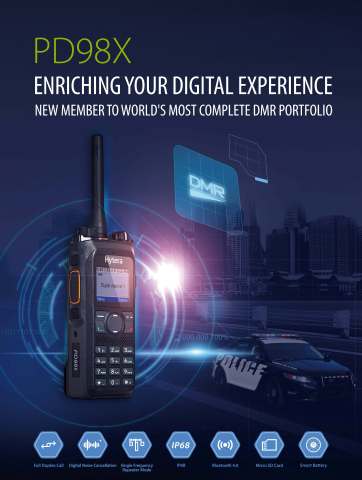
Hytera have a wide range of radios in their catalogue now, and this is a new addition. The PD98X is for the professional communicator, a radio that has more added extras than a lot of smart phones. A couple of questions we would like to ask are:

What will the price be?

Can I use my current Hytera earpiece with this radio?

And when will this be available?

But this does seem to be a nice addition to the Hytera range and we can’t wait to try it out.

Hytera, a leading solution provider of professional mobile radio communications, has launched its latest digital mobile radio (DMR) handheld PD98X, adding another strong member to its top-notch DMR portfolio.

PD98X offers an exceptional audio experience through noise cancellation technology, while boasting new features including full duplex calls, recording capability via Micro SD, Bluetooth 4.0 for audio or data and single frequency repeater mode to increase coverage, said a statement from the company.

GS Kok, senior vice president of Hytera, said: “We are proud to announce the launch of PD98X.”

“A series of cutting-edge innovations and designs have been added into this new model to make it a full-featured radio to satisfy customers' increasing demand for functionality and user experience,” he said.

The addition of the PD985 positions Hytera with the most complete DMR radio portfolio to meet diversified requirements, from simple, reliable and cost-effective handsets (PD3 and PD4 series) to rugged and feature-rich solutions (PD5 and PD6 series), up to the high-end, professional system radios (PD7, PD9 and X1 series), it said.

The key advanced features of PD98X include:

•Full Duplex Call

PD98X enables frontline personnel to make telephony calls between other PD98X and telephones or mobile phones.

•Single Frequency Repeater Mode


Based on interference cancellation technology, PD98X is able to use one slot to receive a signal and another to transmit it in the same frequency using DMO mode to extend the communication distance.

•Built-in Bluetooth 4.0

With integrated Bluetooth 4.0, PD98X supports both audio transmit and programming via Bluetooth.

•Noise Cancellation and 2.5W Audio Output

Maximum 2.5W output speaker and new noise cancelling technology ensure clear and loud voice communication.

•IP68 Protection

PD98X complies with the highest dust and waterproof standards, to confront the harshest environments. The radio continues to function after submersion down to 2 meters for up to four hours.

•Smart Battery

This feature makes it easier to monitor the battery status, such as battery life time and charging time, reducing charging time dramatically.

•Audio Recording via Micro SD Card

PD98X supports up to a 32GB Micro SD card, to record up to 576 hours digital/analog audio.

The whole portfolio offers display and non-display, GPS and non-GPS, UHF and VHF versions, allowing customers to select the best handset for their daily operation and mission-critical scenarios,

Source - http://www.tradearabia.com/news/IND_312771.html